menu
News #19

2025 Vintage
by Brice de La Morandière
Early August, the vine promised us a very fine vintage: qualitative, generous, and certainly early. Nature then tested our ability to adapt with a relatively long heatwave in mid-August, accelerating ripening, and the forecast of heavy rains at the end of the month, just when harvest was scheduled. As every year, we adapted to natural conditions, without compromising our quest for quality.
Our goal is always to prioritize the balance between technical and phenolic ripeness, refusing any logistical constraints even though we know they exist. We had to adapt our software to find the right harvest date. We decided to move it forward, adjust it for the grand crus and change the structure of the teams.
The 2025 harvest particularly challenged us with, in fact, two successive heatwaves—a first one of about ten days at the end of June, and then the one in August—and the impending rainfall. Experience, of course, helps in decision-making, but doubts can still linger, and that’s partly the beauty of winemaking. A thoughtful exchange with winemaker friends contributes to the reflection and leads us to take a few more risks...
Overall, the wine year went well. The water tables had been well replenished by the rainy 2024 vintage and a classic, wet 2025 winter, without excessive cold. The early spring period, now feared for its risk of morning frosts, also went well, and the wind machines we deployed didn’t need to be turned on. Some rain during flowering, around June 1st, caused a bit of coulure, which limited the harvest potential without affecting quality. After the first heatwave, July was consistent with seasonal averages, with no excess sun or rain. The grapes were in excellent health.
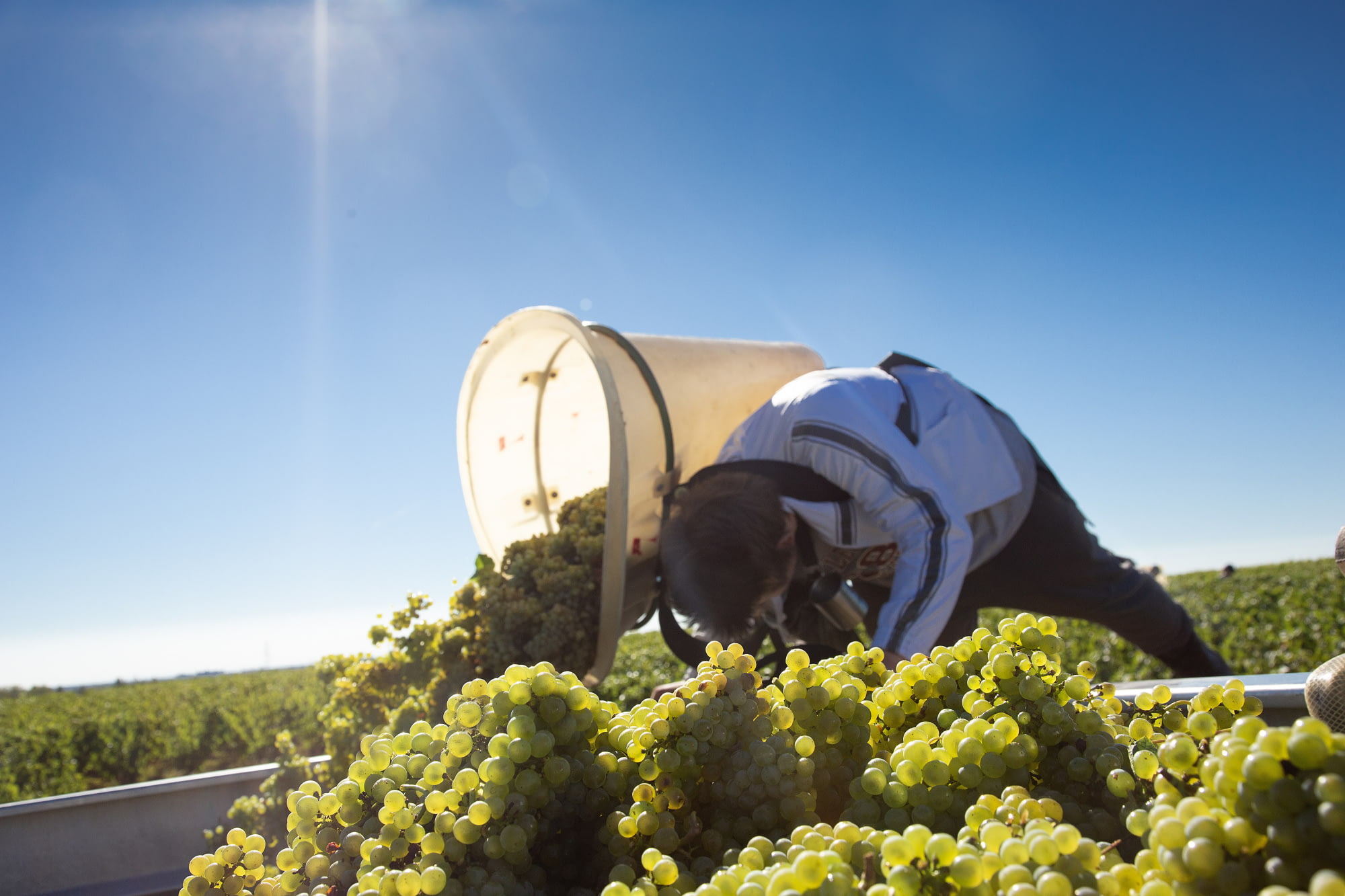
The second heatwave changed the profile of the vintage. The grapes ripened faster, acidity decreased, and a potentially stormy and particularly rainy front developed for the end of the month. We decided to begin the harvest on August 22nd in pleasant weather. We finished on the evening of the first rain, which would prove to be as abundant as expected in the days that followed. The 2025 vintage turned out to be modest in quantity, with beautiful concentration and delicate aromatic purity.

Portrait of Louis Brière
From his very first days at Domaine Leflaive, Louis Brière understood that it is long time spans that shape the great wines of Burgundy. At only 46, Louis is already part of the Domaine’s living memory. He remembers precisely the day he joined the house, in January 2008. "Anne-Claude Leflaive told me back then: 'I’m hiring you for twenty-five years.'" And soon it will be eighteen years!
As cellar master in Puligny-Montrachet, he defines his role as a meticulous mission: "Taking care of the wines on a daily basis." He’s careful not to claim sole ownership of this task because it is a team effort. To support him, he can rely on a winemaker and a cellar technician, as well as three people handling labeling and shipments.
Louis was born in Carcassonne, far from Burgundy. After starting his career in Alsace as a service provider for the Paetzold Group, which designs oenotechnical solutions, he had always dreamed of working in a vineyard he deeply admired. "I consider myself Burgundian," he dares to say. "I love the region, I love the complexity of its wines. If you take Chardonnay alone, it's the same grape, but it expresses itself differently from Chablis to Mâcon!"
Because great wine in these terroirs begins in the vineyard, the cellar master is delighted with the grapes at his disposal: "At Domaine Leflaive, we are fortunate to work in continuity, always prioritizing the quality of the grapes, and thus the quality of our wines. The creation of these great wines takes place through collective tasting sessions, which occur regularly throughout the life of the estate."
The cellar master’s job is about balancing certainty and doubt, knowing how to manage both. "At Domaine Leflaive, we don’t change the aging methods based on trends; we adapt to the vintages. Simply because wine is alive!"

We love it, we support it!
With this new section, Domaine Leflaive aims to shine a spotlight on a Burgundy-related event or initiative.
An annual association event launched in 2019, the Trophée des Bourgognes brings together students and winemakers around the region's wines. Very few competitions are dedicated to a specific wine-growing area. "We created the event to engage the new generation of consumers, perhaps in a typically Burgundy way—educational and friendly! And it will feel like a victory the day an alumnus returns to a winery, ten years after participating, to become a purchaser of a wine they once tasted," explain the organizers.
Over the course of a weekend, and a friendly yet fiercely contested competition, the 2025 edition gathered fifteen teams from the best French and European schools and universities (Polytechnique, AgroParisTech, ENS, Dauphine, Oxford, Cambridge…). The competition took place on Saturday, October 18, at Château de Meursault, followed by a Paulée that evening, bringing together participants and partners in the cellars. The following day was dedicated to visits and tastings in Pommard, as part of an annual tradition revolving around a village in the Côte de Beaune.
The Trophée des Bourgognes also breaks the conventions of such competitions and blind tastings, where participants often go through a series of red, white, and sweet wines, including mystery wines. "After a first theoretical round, we offer four series of four wines, always consisting of two reds and two whites side by side," continue the organizers. "The students are asked to first identify the appellation level, then the sub-region, the village... Every year, we are impressed by the very high level of the participants."
Educational, the Trophée des Bourgognes also aims to place the tasting in the context and culture of the Climats. Over 40 partner winemakers, family estates, négociants, and cooperatives have contributed to its success for nearly seven years.
This event was conceived by Achille de La Morandière, Henri Frangin and Maguelone Dunoyer.